- Hybrid Cloud vs Multi-Cloud: A Complete Guide for Businesses
- What is Hybrid Cloud?
- Key Benefits of Hybrid Cloud
- What is Multi-Cloud?
- Key Benefits of Multi-Cloud
- Hybrid Cloud vs Multi-Cloud: Major Differences
- When Should Businesses Choose Hybrid Cloud?
- When Should Businesses Choose Multi-Cloud?
- Challenges of Hybrid Cloud
- Challenges of Multi-Cloud
- Hybrid Cloud vs Multi-Cloud: Which One is Better?
- How VyomCloud Helps Businesses Build Reliable Cloud Infrastructure
- Conclusion
- Related Reading
- FAQs
- 1. What is the difference between Hybrid Cloud vs Multi-Cloud?
- 2. Is Hybrid Cloud more secure than Multi-Cloud?
- 3. Why do companies use Multi-Cloud strategies?
- 4. Can a business use both Hybrid Cloud and Multi-Cloud?
- 5. Which cloud model is more cost-effective?
- 6. What industries benefit most from Hybrid Cloud?
Hybrid Cloud vs Multi-Cloud: A Complete Guide for Businesses
Cloud computing has become the backbone of modern business operations. Companies now rely on the cloud to store data, run applications, support remote teams, and scale services quickly. As organizations grow, choosing the right cloud deployment model becomes critical for performance, security, cost, and compliance. Two strategies often compared are Hybrid Cloud and Multi-Cloud. Both offer powerful advantages, but they serve different business needs. This guide explains what Hybrid Cloud and Multi-Cloud mean, how they work, and when to use each approach. You will learn about their benefits, challenges, and practical decision criteria so business owners, startups, developers, and IT teams can make informed choices for their business cloud infrastructure. Many businesses, including companies using VyomCloud’s cloud hosting solutions, are successfully implementing both hybrid and multi-cloud strategies.
What is Hybrid Cloud?
Hybrid cloud is a deployment model that combines private cloud or on-premises infrastructure with one or more public cloud services. The private and public parts connect through secure networks, allowing workloads and data to move between environments as needed. In a hybrid cloud setup, sensitive or critical workloads typically run in the private environment while less-sensitive or highly scalable workloads operate on the public cloud. This combination gives businesses the control and security of private systems along with the flexibility and scale of public cloud providers.
A real-world example helps clarify how hybrid cloud works in practice. Consider a healthcare organization that stores patient records in a private cloud to meet strict privacy regulations. The same organization runs its customer-facing website and mobile app on public cloud servers. During peak seasons, the organization temporarily scales the public cloud portion to handle higher traffic without exposing sensitive patient data. This setup delivers both compliance and elasticity.
Key Benefits of Hybrid Cloud
Hybrid cloud offers several advantages that make it attractive for many organizations. One major benefit is flexibility. Businesses can move workloads between private and public environments based on demand, cost, or policy requirements. This flexibility supports dynamic business needs without requiring major infrastructure changes. Another key advantage is better security for sensitive data. By keeping regulated or confidential information in private infrastructure, organizations maintain tighter control over access, encryption, and monitoring.
Cost optimization is another important benefit. Hybrid cloud allows companies to avoid overprovisioning private servers for workloads that only spike occasionally. Instead, they can use public cloud resources during peak periods and scale back when demand drops. Scalability also improves significantly. Organizations can expand into the public cloud quickly to handle traffic surges, new product launches, or seasonal demand without purchasing additional hardware. Finally, hybrid cloud supports compliance advantages. Many industries have strict rules about where data must reside and how it must be protected. Hybrid architecture lets businesses keep regulated data in compliant private environments while using public cloud for non-regulated tasks.
What is Multi-Cloud?
Multi-cloud refers to using services from two or more public cloud providers simultaneously. Unlike hybrid cloud, multi-cloud does not necessarily include private infrastructure. Instead, it focuses on distributing workloads across multiple public clouds to achieve specific business goals. Companies adopt multi-cloud strategies to access best-in-class services from different providers, reduce dependence on a single vendor, or place workloads closer to users in different regions.
Businesses use multiple cloud providers in various ways depending on their needs. An e-commerce company might use one provider for web hosting, another for payment processing, and a third for analytics and machine learning. A global startup could deploy regional clusters with different public clouds to reduce latency for users in different continents. These examples show how multi-cloud allows organizations to pick the right tool for each job rather than forcing all workloads into a single provider.
Key Benefits of Multi-Cloud
Multi-cloud strategies offer distinct advantages that appeal to many modern enterprises. One major benefit is reduced vendor lock-in. By spreading workloads across multiple providers, companies avoid becoming entirely dependent on one vendor’s tools, pricing, or policies. This flexibility gives businesses more negotiating power and reduces risk if a provider changes terms or experiences issues. Better reliability is another important advantage. If one cloud provider has an outage, other clouds can continue running critical workloads, maintaining business operations.
Access to specialized cloud services is a key driver for multi-cloud adoption. Different providers excel in different areas. One might offer superior artificial intelligence tools, another might have advanced database capabilities, and a third could provide unique networking features. Multi-cloud lets organizations use the best service from each provider. Improved performance is also possible because businesses can place workloads closer to users using regionally optimal clouds. Finally, multi-cloud supports business continuity by providing multiple disaster recovery options and reducing the chance that a single provider failure will shut down operations.
Hybrid Cloud vs Multi-Cloud: Major Differences
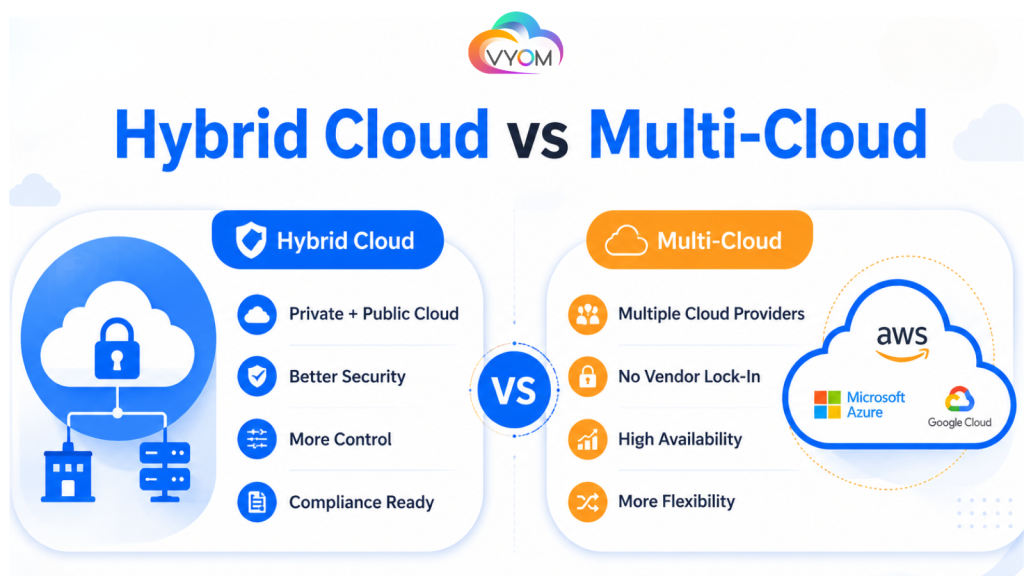
Understanding the differences between hybrid cloud and multi-cloud helps businesses choose the right approach. Hybrid cloud architecture blends private and public environments, while multi-cloud architecture uses multiple public providers without necessarily involving private infrastructure. In terms of deployment model, hybrid combines on-premises or private cloud with public cloud, whereas multi-cloud deploys across several public providers only.
Security differs significantly between the two models. Hybrid cloud often provides stronger control over sensitive data because organizations can keep regulated workloads in private infrastructure with customized security policies. Multi-cloud relies on each provider’s security measures and requires consistent policies across all providers. Cost structures also vary. Hybrid cloud can reduce public cloud spend for steady workloads but requires investment in private infrastructure. Multi-cloud can optimize costs across providers but increases management overhead and complexity.
Scalability works well in both models but requires different coordination. Hybrid cloud needs seamless integration between private and public environments for workloads to scale properly. Multi-cloud scales using combined public resources from multiple providers. Management complexity differs as well. Hybrid cloud adds integration challenges between environments, while multi-cloud increases cross-provider management and skill requirements.
Vendor dependency represents another key difference. Hybrid cloud reduces public cloud dependency but introduces commitments to private infrastructure. Multi-cloud minimizes single-vendor lock-in by distributing workloads across providers. Performance characteristics also vary. Hybrid cloud can offer consistent performance for sensitive workloads on private infrastructure, while multi-cloud can place services nearer to users for improved latency. Compliance considerations favor hybrid cloud for strict regulatory needs, while multi-cloud requires careful policy alignment across all providers to meet compliance requirements.
When Should Businesses Choose Hybrid Cloud?
Hybrid cloud works best for industries with strict security, compliance, or data residency requirements. Healthcare organizations, financial institutions, government agencies, and companies handling sensitive personal data often benefit most from hybrid cloud. These industries need to keep regulated data under tight control while still taking advantage of cloud scalability for non-sensitive workloads.
Security-focused organizations typically prefer hybrid cloud because it allows them to maintain direct control over sensitive infrastructure. For example, a bank might keep customer account databases in a private cloud while running its mobile banking app on public cloud servers. A manufacturing company could store intellectual property and proprietary designs in private infrastructure while using public cloud for supply chain management and customer portals. These use cases demonstrate how hybrid cloud balances security with flexibility.
When Should Businesses Choose Multi-Cloud?
Multi-cloud strategies suit global businesses with users spread across different regions. These companies benefit from placing workloads closer to users using different public clouds in different geographic areas, which reduces latency and improves user experience. Large enterprises often adopt multi-cloud to avoid vendor lock-in and gain access to specialized services from multiple providers.
Organizations with high availability requirements also benefit from multi-cloud. By distributing workloads across multiple providers, companies reduce the risk that a single provider outage will disrupt operations. Businesses with specialized workload requirements find multi-cloud particularly valuable. If certain workloads need specific AI capabilities, advanced analytics, or unique networking features that only one provider offers, multi-cloud allows organizations to use those specialized services without committing their entire infrastructure to one vendor.
Challenges of Hybrid Cloud
Hybrid cloud comes with several challenges that organizations must address. Infrastructure management becomes more complex because teams must maintain both private and public environments. This requires coordination between different systems, monitoring tools, and operational processes. Integration complexity is another significant challenge. Ensuring seamless data flow and workload orchestration between private and public clouds requires careful planning, robust networking, and often specialized management tools.
Security management also becomes more difficult in hybrid environments. Organizations must maintain consistent security policies across private and public environments, which requires strong governance, monitoring, and automation. Without proper controls, security gaps can emerge between environments that attackers might exploit.
Challenges of Multi-Cloud
Multi-cloud strategies introduce their own set of challenges. Managing multiple vendor relationships requires significant time and effort. Teams must negotiate separate service-level agreements, contracts, and billing arrangements for each provider. Cost monitoring becomes complex because spending occurs across multiple platforms with different pricing models and billing cycles. Without centralized visibility, organizations may underestimate total cloud costs.
Security consistency is another major challenge. Ensuring uniform security configurations, identity policies, and access controls across different providers requires careful planning and ongoing management. Each provider has different tools and interfaces, which increases the skill requirements for IT teams. Staff must become proficient with multiple platforms, raising hiring and training costs.
Hybrid Cloud vs Multi-Cloud: Which One is Better?
Neither hybrid cloud nor multi-cloud is inherently better. The best choice depends entirely on your business needs, priorities, and constraints. Organizations that prioritize security, compliance, and control over sensitive data typically benefit more from hybrid cloud. This model allows them to keep regulated workloads in private infrastructure while using public cloud for elasticity and scalability.
Businesses that want to avoid vendor lock-in, access specialized services, or maximize global reach often find multi-cloud more suitable. This model provides flexibility to use the best services from different providers and reduces dependence on any single vendor. For companies with tight budgets and small teams, a single public cloud might be simpler to manage initially, with plans to evolve toward hybrid or multi-cloud as needs grow.
Decision-makers should evaluate their current workloads, identify sensitive data, estimate traffic patterns, and model costs for both approaches. Considering growth plans, security requirements, and available technical skills will clarify which model fits best. Many organizations eventually combine elements of both, starting with one approach and expanding into the other as requirements evolve.
How VyomCloud Helps Businesses Build Reliable Cloud Infrastructure
VyomCloud provides cloud hosting solutions that support both hybrid cloud infrastructure and multi-cloud strategies. The company offers services designed for businesses that need performance, security, and expert support without complex management overhead.
VyomCloud’s cloud servers deliver high-performance computing resources optimized for a wide range of workloads. These servers provide fast compute performance for web applications, databases, and backend services. For smaller projects and development teams, VyomCloud’s VPS hosting offers predictable resources, easy scaling, and cost-effective performance. When organizations need full control and dedicated resources, VyomCloud’s dedicated servers provide secure, single-tenant environments suitable for sensitive workloads and legacy applications.
Managed cloud solutions from VyomCloud handle infrastructure management, monitoring, backups, and security. This reduces operational overhead and helps organizations adopt hybrid or multi-cloud models more smoothly. VyomCloud invests in high-speed networking and SSD storage to ensure low-latency performance, which is critical for user experience and data processing tasks. Security features include firewalls, DDoS protection, and secure access controls that help maintain a secure cloud infrastructure and support compliance requirements.
Scalability options allow businesses to grow without disruptive infrastructure changes. Whether scaling vertically or horizontally, teams can adjust resources quickly through VyomCloud’s platform. This combination of cloud servers, VPS hosting, dedicated servers, and managed services makes VyomCloud a practical partner for businesses building hybrid cloud architecture or implementing multi-cloud strategies.
Conclusion
Hybrid Cloud vs Multi-Cloud represents two distinct paths for modern business cloud infrastructure. Hybrid cloud blends private and public environments to provide strong control, compliance advantages, and targeted cost savings. Multi-cloud uses multiple public providers to reduce vendor lock-in, improve reliability, and access specialized services. Each model serves different business needs.
Choose hybrid cloud when security, compliance, and data control are critical priorities. Choose multi-cloud when global reach, specialized services, and high availability matter most. Many successful organizations combine elements of both strategies, starting with one model and expanding into the other as requirements evolve. Before deciding, map your workloads, identify sensitive data, forecast traffic patterns, and run a cost and skills assessment. Consider partners like VyomCloud to simplify infrastructure, improve security, and accelerate cloud adoption for your business.
Related Reading
What is Paperclip? Complete Beginner Guide 2026
Paperclip App Review: Features, Benefits & Use Cases (2026)
Also Read:- How to Build Automation Workflows Using n8n
Let’s Get Social:
Facebook: https://www.facebook.com/vyomcloudnetwork/
LinkedIn: https://www.linkedin.com/company/vyomcloud/
Instagram: https://www.instagram.com/vyomcloud/
FAQs
1. What is the difference between Hybrid Cloud vs Multi-Cloud?
Hybrid Cloud combines private and public cloud environments and focuses on control and compliance. Multi-Cloud uses multiple public cloud providers to reduce vendor dependency and access specialized services.
2. Is Hybrid Cloud more secure than Multi-Cloud?
Hybrid cloud can offer stronger control for sensitive data because you can keep regulated workloads in private infrastructure. Security ultimately depends on how well each model is configured and managed.
3. Why do companies use Multi-Cloud strategies?
Companies use multi-cloud to avoid vendor lock-in, gain access to the best services from different providers, improve resilience, and place services closer to users for better performance.
4. Can a business use both Hybrid Cloud and Multi-Cloud?
Yes. A business may use private infrastructure for critical data in a hybrid setup while using multiple public clouds for different workloads in a multi-cloud strategy. Combined approaches provide flexibility and resilience.
5. Which cloud model is more cost-effective?
Cost-effectiveness depends on workloads and scale. Hybrid cloud can be cheaper for steady-state workloads if private infrastructure is efficient. Multi-cloud can optimize costs across providers but adds management overhead.
6. What industries benefit most from Hybrid Cloud?
Healthcare, finance, government, and any industry with strict compliance and data residency requirements often benefit from hybrid cloud.