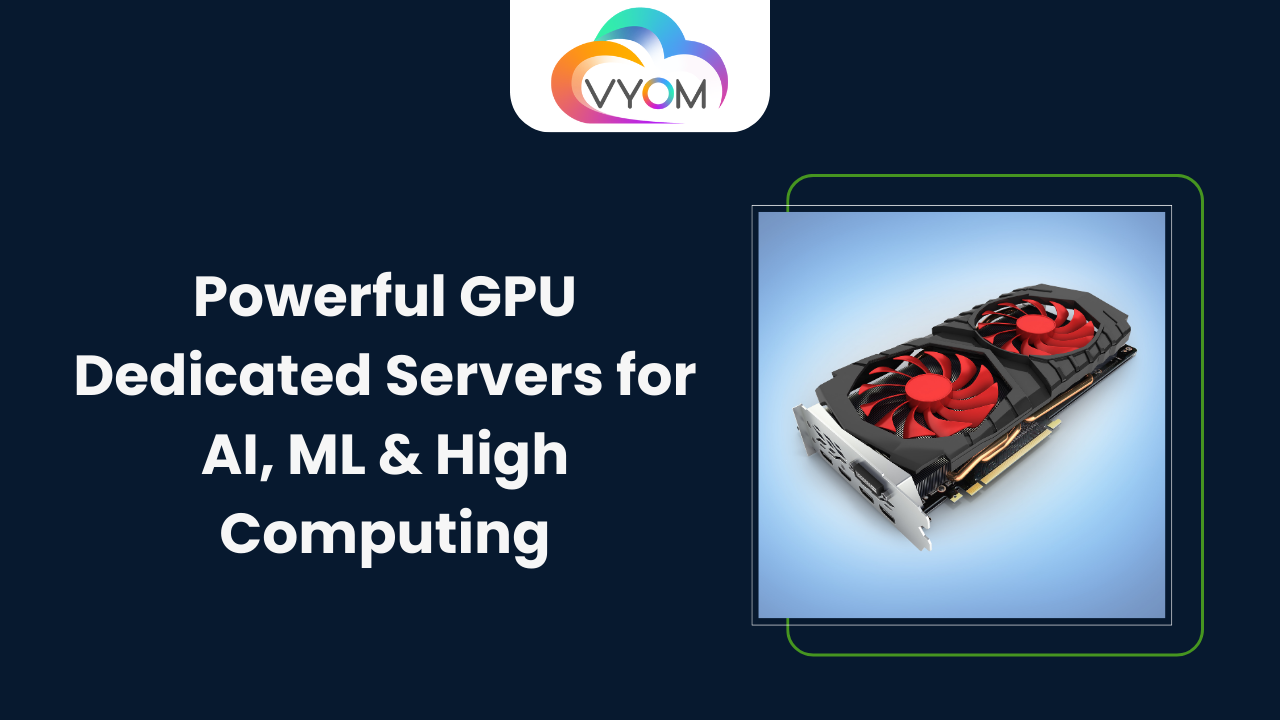
- Powerful GPU Dedicated Servers for AI, ML & High Computing
- What Are GPU Dedicated Servers?
- Why GPUs Are Critical for AI and Machine Learning
- Parallel Processing Capabilities
- Faster Model Training and Inference
- Performance Consistency
- Security and Data Isolation
- Artificial Intelligence and Deep Learning
- Machine Learning Model Development
- Scientific Research and Simulations
- Media Rendering and Visualization
- Exceptional Computing Power
- Full Hardware Control
- Scalability for Growing Demands
- Higher Initial Cost, Greater Long-Term Value
- Optimized Resource Utilization
- Compliance and Data Protection
- Monitoring and Access Management
- Evaluate Workload Requirements
- Consider Long-Term Scalability
- Support and Reliability
Powerful GPU Dedicated Servers for AI, ML & High Computing
GPU Dedicated Servers have become essential for organizations that work with data-intensive and compute-heavy workloads. Unlike standard CPU-based systems, GPU-powered servers process thousands of parallel tasks at once. As a result, they deliver exceptional performance for artificial intelligence, machine learning, deep learning, and high-performance computing applications. Businesses across industries now rely on GPU infrastructure to accelerate innovation and reduce processing time.
According to industry reports, GPU-accelerated workloads can perform up to 10–50 times faster than CPU-only systems for AI and ML tasks. Moreover, global adoption of AI-driven solutions is growing at over 20% annually. Because of this growth, Dedicated Server Hosting with GPUs has become a preferred choice for enterprises, startups, and research institutions.
In this knowledge base article, we will explain how GPU dedicated servers work. We will also discuss their benefits, use cases, performance advantages, and key factors to consider. Additionally, the blog aims to create awareness about why GPU-based dedicated servers are critical for modern computing needs.
What Are GPU Dedicated Servers?
GPU dedicated servers are physical servers equipped with high-performance graphics processing units. These servers are fully dedicated to a single user. Therefore, all computing power, memory, and GPU resources remain exclusive.
Unlike shared or virtual environments, GPU dedicated servers eliminate resource contention. Moreover, they provide consistent performance for demanding workloads. In addition, organizations gain complete control over configurations, operating systems, and software stacks.
Dedicated Server Hosting with GPUs is especially useful for applications that require massive parallel processing. As a result, tasks such as model training, data simulation, and rendering run significantly faster.
Why GPUs Are Critical for AI and Machine Learning
Parallel Processing Capabilities
GPUs are designed to handle thousands of operations simultaneously. CPUs, however, focus on sequential processing. Because AI and ML algorithms involve large matrix calculations, GPUs complete these tasks efficiently.
Moreover, training deep learning models on GPUs reduces training time from weeks to hours. As a result, organizations can experiment faster and deploy models sooner.
Faster Model Training and Inference
GPU Dedicated Servers accelerate both training and inference stages. Meanwhile, faster inference improves real-time applications such as recommendation engines and image recognition systems. Therefore, user experience improves significantly.
Dedicated Server Hosting vs Shared GPU Environments
Performance Consistency
In shared GPU environments, multiple users access the same resources. However, performance can fluctuate during peak usage. Dedicated Server Hosting removes this issue by allocating all resources to a single tenant.
Moreover, consistent performance is crucial for long-running AI workloads. Therefore, dedicated GPU servers provide better reliability.
Security and Data Isolation
Dedicated servers offer complete data isolation. In addition, organizations can implement custom security policies. As a result, sensitive datasets remain protected.
High-Performance Computing Use Cases
Artificial Intelligence and Deep Learning
AI workloads require massive computational power. GPU dedicated servers handle neural networks, natural language processing, and computer vision tasks efficiently. Moreover, they support popular frameworks without performance bottlenecks.
Machine Learning Model Development
ML workflows involve data preprocessing, training, and testing. GPUs speed up these processes. Additionally, faster iterations lead to better model accuracy.
Scientific Research and Simulations
Researchers use GPU servers for weather modeling, genomics, and physics simulations. Because GPUs process complex calculations quickly, research timelines shorten.
Media Rendering and Visualization
GPU dedicated servers are also ideal for video rendering, 3D modeling, and animation. As a result, creative teams can meet tight production deadlines.
Key Benefits of GPU Dedicated Servers
Exceptional Computing Power
GPU servers deliver high throughput and low latency. Moreover, they outperform traditional servers in compute-heavy tasks. Therefore, businesses achieve faster results.
Full Hardware Control
Dedicated Server Hosting allows users to customize hardware and software. In addition, users can install specialized drivers and libraries. This flexibility supports advanced workloads.
Scalability for Growing Demands
Organizations can scale GPU resources as workloads increase. Meanwhile, this scalability ensures long-term infrastructure readiness.
Understanding Cost Efficiency in GPU Dedicated Servers
Higher Initial Cost, Greater Long-Term Value
GPU servers cost more than standard servers. However, they complete tasks faster. As a result, overall project costs may decrease.
Optimized Resource Utilization
With dedicated GPUs, there is no resource sharing. Therefore, organizations fully utilize available computing power. Additionally, this efficiency improves ROI.
Security Advantages of Dedicated GPU Hosting
Security is a major concern for AI and data-driven applications. Dedicated GPU servers offer physical isolation. Moreover, users can implement advanced firewalls and encryption.
Compliance and Data Protection
Many industries require strict compliance. Dedicated servers help meet regulatory standards. In addition, data remains under full organizational control.
Monitoring and Access Management
Administrators can monitor workloads continuously. Meanwhile, role-based access ensures only authorized users interact with systems.
How to Choose the Right GPU Dedicated Server
Evaluate Workload Requirements
First, analyze workload size and complexity. Some tasks require high VRAM, while others need more GPU cores. Therefore, selecting the right configuration is essential.
Consider Long-Term Scalability
Choose a provider that supports upgrades. Additionally, ensure compatibility with future technologies. This approach reduces migration challenges.
Support and Reliability
Reliable technical support is critical. Moreover, hardware monitoring and rapid issue resolution minimize downtime.
Industries Benefiting from GPU Dedicated Servers
Many industries rely on GPU Dedicated Servers today. Healthcare uses them for medical imaging and diagnostics. Finance applies them for risk modeling and fraud detection. Meanwhile, autonomous systems depend on GPU power for real-time decision-making.
In addition, education and research institutions use GPUs for advanced simulations. As a result, innovation accelerates across sectors.
Conclusion
GPU Dedicated Servers play a crucial role in AI, ML, and high-performance computing. Through Dedicated Server Hosting, organizations gain exclusive access to powerful GPU resources, consistent performance, and enhanced security. Moreover, faster processing enables quicker innovation and better outcomes.
This knowledge base article aimed to create awareness about the importance of GPU-powered infrastructure. By understanding benefits, use cases, and selection criteria, businesses can make informed decisions. Ultimately, GPU dedicated servers provide the foundation for scalable, future-ready computing solutions.