- What Is Cage Colocation? Benefits, Features & Use Cases Explained
- What Is Cage Colocation?
- How Cage Colocation Works in a Data Center
- Cage Colocation vs Rack vs Suite
- Key Benefits of Cage Colocation
- Main Features of a Cage Colocation Setup
- Common Use Cases for Cage Colocation
- When Should You Choose Cage Colocation?
- How to Get Started with Cage Colocation
- Final Thoughts
- Related Reading
- FAQs
What Is Cage Colocation? Benefits, Features & Use Cases Explained
In the world of cloud and data‑center hosting, cage colocation has become a popular choice for businesses that want more control than open racks but don’t need a full private suite. Whether you’re a startup, an e‑commerce operator, or a growing SaaS company, understanding what cage colocation is and how it works can help you choose the right infrastructure model for your IT needs.
In this guide, you’ll learn:
-
What exactly does cage colocation mean
-
How it differs from rack and suite‑based colocation
-
Key benefits and features of cage setups
-
Real‑world use cases where cage colocation makes the most sense
And you’ll also see how providers like Vyom Cloud cage colocation fit into this ecosystem, offering tailored solutions for Indian businesses that need secure, scalable hosting.
What Is Cage Colocation?
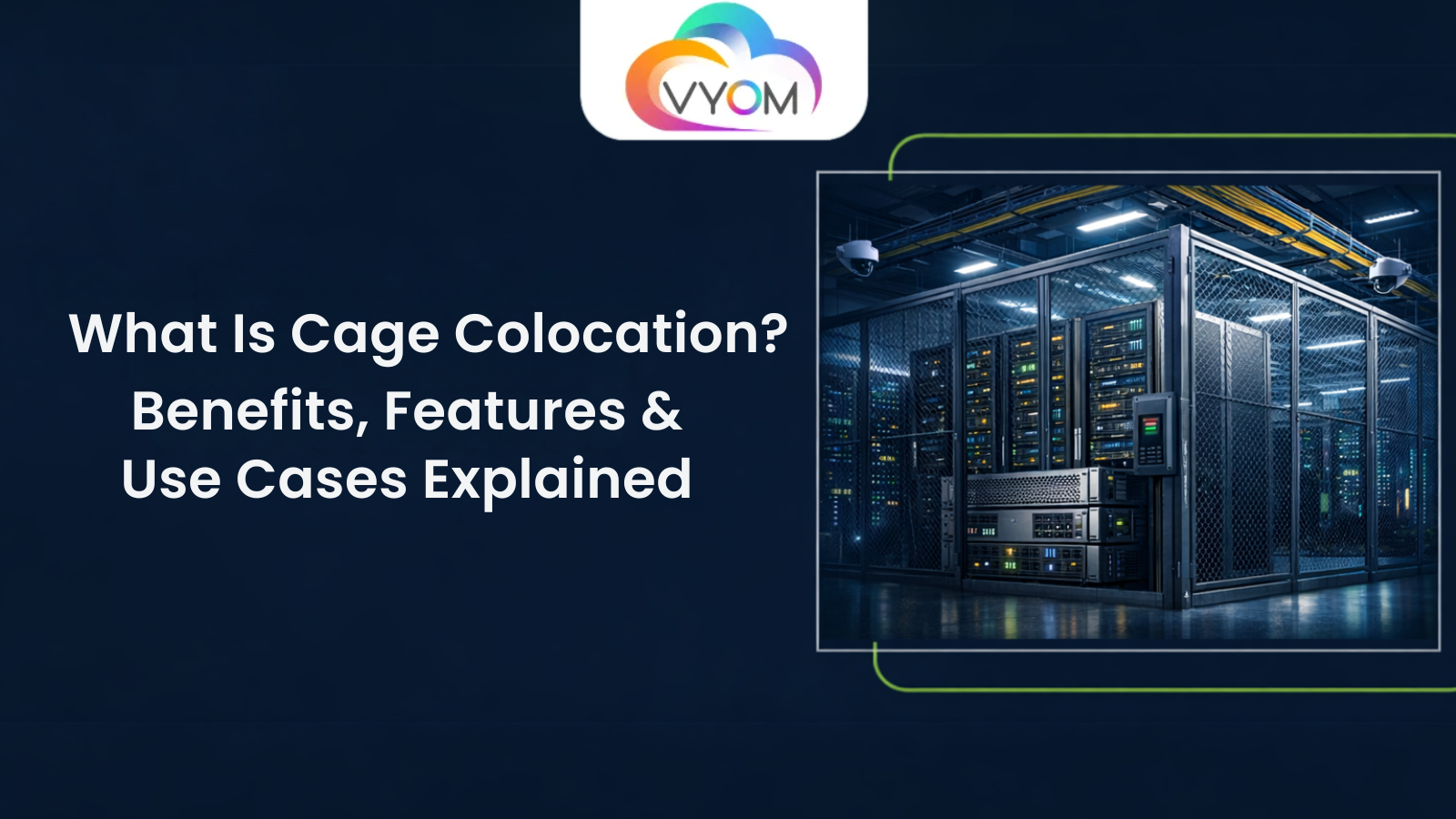
Cage colocation refers to a dedicated, enclosed space within a data‑center facility that belongs to a single customer or organization. Instead of sharing an open rack with other clients, your servers and networking gear sit inside a secure, fenced or wall‑enclosed “cage” that only authorized staff can access. These cages are usually built with metal mesh or solid walls and can hold multiple server racks, switches, and storage units. The data center still provides the core infrastructure—power, cooling, bandwidth, and physical security—while you own and manage the hardware inside your cage.
This is where services like Vyom Cloud cage colocation come in. Vyom Cloud offers customers access to secure, carrier‑neutral data centers with professionally managed cage setups, giving Indian businesses a local, high‑performance option without long‑term capex.
How Cage Colocation Works in a Data Center
In a typical cage colocation setup:
-
The provider reserves a clearly defined area on the data center floor for your organization.
-
This area is then enclosed with a secure cage structure (often wire mesh or solid panels).
-
Your racks are installed inside the cage, connected to shared power, cooling, and network infrastructure.
Because the cage is privately assigned, you can:
-
Lock the cage door with access‑control systems.
-
Install your own monitoring or CCTV inside the enclosure.
-
Arrange the racks and cabling in a way that suits your workloads.
This model sits between rack colocation (single locked cabinets shared in a common area) and suite colocation (entire private rooms or suites). Cage colocation is often described as a semi‑private environment that balances security, cost, and flexibility.
Cage Colocation vs Rack vs Suite
To understand cage colocation, it helps to compare it with the two other common options: rack colocation and suite colocation.
| Option | What It Includes | Security Level | Flexibility | Typical Use Case |
|---|---|---|---|---|
| Rack colocation | One or more shared racks in an open data‑center area | Lower | Moderate | Small businesses, startups, light apps |
| Cage colocation | Enclosed, client‑dedicated space with multiple racks | Medium–High | High | Growing enterprises, regulated workloads |
| Suite colocation | Full private room or suite for a single client | Highest | Very high | Large enterprises have strict compliance needs |
Cage colocation stands out because it gives you more privacy than racks at a lower cost than full suites. You still share the broader data‑center infrastructure, but your own hardware sits in a physically separated, secure zone.
For Indian businesses, Vyom Cloud cage colocation offers a practical middle path—letting you scale from a few racks to a full cage without switching providers or locations.
Key Benefits of Cage Colocation
If you’re evaluating hosting options, here are the main benefits of cage colocation:
1. Enhanced Physical Security
One of the biggest reasons businesses choose cage colocation is security. The cage acts as a physical barrier that prevents unauthorized access to your servers and networking gear. Many providers add:
-
Access‑control systems (card readers, biometrics) on the cage door.
-
Surveillance cameras cover the cage area.
-
Alarms or alerts for tampering or forced entry.
This makes cage colocation especially attractive for companies handling sensitive data, such as finance, healthcare, or e‑commerce platforms.
With Vyom Cloud cage colocation, security is built into the design, including access logs, 24/7 monitoring, and procedures that align with standard data‑center best practices in India.
2. Better Privacy and Control
Inside your cage, you have more control over things like:
-
Equipment layout and rack placement.
-
Cable routing and labeling.
-
Internal monitoring and sensors.
Unlike shared racks, where someone else’s hardware is right next to yours, the cage gives you a private, branded space within the data center. That privacy also helps with compliance requirements, since auditors can clearly identify your infrastructure boundary.
Vyom Cloud cage colocation lets customers define their own internal layout while still benefiting from shared power, cooling, and connectivity, making it ideal for teams that want to manage their own hardware stack.
3. Scalability Without Major Overhauls
Cage colocation is highly scalable. Instead of moving to a new data center or a completely different setup, you can:
-
Add more racks or cabinets inside the same cage.
-
Upgrade power and cooling capacity as needed.
-
Reconfigure the layout without disrupting other clients.
This scalability is useful for businesses that experience rapid growth, seasonal spikes, or evolving workloads (for example, AI training clusters or expanding game‑server networks).
For companies using Vyom Cloud cage colocation, scaling often means simply adding more racks or increasing bandwidth, without the need to rebuild your entire infrastructure.
4. Cost‑Efficiency Compared to Full Suites
While full private suites offer maximum isolation, they come with higher costs and more infrastructure overhead. Cage colocation gives you:
-
Dedicated, secure space.
-
Shared data‑center utilities (power, cooling, internet).
-
Lower entry and operating costs than a full suite.
If your goal is to reduce capital expenditure on building your own data center, cage colocation is often the most balanced option.
Vyom Cloud cage colocation emphasizes this cost‑efficiency model, providing Indian businesses with a flexible, pay‑as‑you‑grow approach that avoids heavy upfront investments.
5. Improved Compliance and Audit Readiness
For industries with strict regulations (like GDPR, HIPAA, PCI‑DSS, or RBI‑style banking norms), cage colocation helps you:
-
Clearly separate your infrastructure from others.
-
Implement access logs and monitoring specific to your cage.
-
Show auditors that your physical environment meets required standards.
Many data centers that offer cage colocation also follow ISO‑certified security and operational practices, which further strengthen your compliance posture.
With Vyom Cloud cage colocation, customers can expect clearly documented processes, access logs, and professional support that helps when preparing for audits or internal reviews.
Main Features of a Cage Colocation Setup
Every cage colocation deployment includes a set of core features that define how your hardware will perform and how you’ll manage it.
1. Physical Enclosure
The cage itself is typically built from:
-
Metal mesh panels (for visibility and airflow).
-
Or solid walls (for maximum privacy and sound isolation).
These enclosures are designed to be sturdy, fire‑resistant, and easy to modify as your infrastructure grows.
Vyom Cloud cage colocation usually offers configurable enclosures that can be expanded or rearranged as your server count increases.
2. Dedicated Power and Redundancy
Most data centers provide:
-
Primary power feeds from the grid.
-
Backup generators and UPS systems.
-
Redundant power circuits inside or near your cage.
This ensures your servers stay online even during power outages or maintenance work elsewhere in the facility.
Vyom Cloud cage colocation typically includes dual‑power feeds and professionally managed UPS systems, helping maintain high uptime for mission‑critical workloads.
3. Advanced Cooling and Airflow
Heat management is critical when you pack multiple racks into one cage. Typical features include:
-
Precision cooling or raised‑floor cooling is directed at your area.
-
Hot‑aisle/cold‑aisle containment aligned with your cage layout.
-
Monitoring of temperature and humidity inside the cage.
These cooling systems help maintain stable performance and extend the lifespan of your hardware.
4. High‑Speed Connectivity
Cage colocation usually comes with:
-
Multiple high‑bandwidth internet links.
-
Peering options with major carriers.
-
Direct cross‑connects to cloud providers or backbone networks.
For businesses running latency‑sensitive applications—like gaming servers, real‑time trading platforms, or video‑streaming services—this connectivity is crucial.
5. Access Control and Monitoring
To secure your cage colocation environment, providers typically offer:
-
Role‑based access control (RBAC) for staff.
-
Logs of who enters and exits the cage.
-
24/7 monitoring of the data‑center floor and cage area.
Some setups even allow you to integrate your own monitoring tools for a more customized view.
With Vyom Cloud cage colocation, access control is usually integrated into the provider’s overall security framework, giving you peace of mind while still keeping things simple to manage.
Common Use Cases for Cage Colocation
Not every business needs a cage, but several scenarios are a perfect fit for cage colocation—including when using a provider like Vyom Cloud cage colocation.
1. Growing E‑Commerce and SaaS Platforms
As online stores and SaaS products scale, they need:
-
More servers to handle traffic spikes.
-
Strict uptime commitments.
-
Clear separation from other tenants.
Cage colocation lets them grow their infrastructure in a controlled, secure environment without the complexity of building their own data center.
2. Financial and Banking Workloads
Banks, fintech apps, and payment gateways often choose cage colocation because:
-
They need strong physical and logical security.
-
They must comply with financial‑sector regulations.
-
They require predictable latency and uptime.
A dedicated cage gives them a clear boundary between their systems and the rest of the data center.
3. Gaming and Low‑Latency Hosting
For gaming server providers, especially those targeting Indian and Asian markets, cage colocation offers:
-
Proximity to local users and ISPs.
-
Dedicated bandwidth and low‑latency connections.
-
A secure, stable environment for multiple game‑server racks.
This setup is ideal if you’re running Minecraft servers, competitive esports platforms, or multiplayer game backends.
4. Healthcare and Data‑Sensitive Applications
Hospitals, telemedicine platforms, and health‑tech startups need to protect patient data and clinical workloads. Cage colocation helps them:
-
Meet data‑protection and privacy requirements.
-
Keep sensitive systems separate from shared infrastructure.
-
Scale compute and storage as their user base grows.
5. Enterprises Avoiding Capex on Data Centers
Many large companies want to host their own hardware but don’t want to invest millions in:
-
Land, buildings, and construction.
-
Power and cooling systems.
-
Security and operations teams.
By opting for cage colocation, they can:
-
Use a Tier‑3+ data‑center facility.
-
Focus on their applications and business logic.
-
Leave the heavy lifting of infrastructure to the provider.
When Should You Choose Cage Colocation?
Cage colocation is not always the best fit for every situation. Here’s a quick checklist:
Choose cage colocation if:
-
You own your own servers and want to keep them.
-
You need more security and privacy than shared racks.
-
You anticipate growth and plan to add more racks over time.
-
You must meet compliance or audit requirements.
-
You want to avoid the cost and complexity of a full private suite.
Consider alternatives if:
-
Your needs are very small (a single rack may be enough).
-
You prefer a fully managed cloud‑only solution.
-
You don’t need any physical separation from other tenants.
If you’re based in India and looking for a provider that offers Vyom Cloud cage colocation, you can match these needs with a local, scalable, and secure hosting option that fits growing businesses.
How to Get Started with Cage Colocation
If you decide cage colocation is right for your business, here’s the typical workflow:
-
Assess your requirements – number of racks, power needs, bandwidth, and location.
-
Shortlist data‑center providers that offer cage colocation in your target region (for example, data centers in Mumbai, Delhi, or Bhopal‑area hubs).
-
Request a site tour or virtual walkthrough to see the cage layout and security controls.
-
Negotiate SLAs – uptime, support response times, power and cooling guarantees.
-
Deploy your racks and integrate monitoring, backups, and cloud‑connect options.
Many providers also offer hybrid colocation options, where your cage can connect seamlessly to public or private cloud environments for true hybrid‑cloud workloads.
Final Thoughts
Cage colocation strikes a smart middle ground between shared racks and full private suites. It gives organizations the security, control, and scalability they need to run mission‑critical workloads, without the high overhead of building their own data center. For businesses that own their hardware but want to leverage professionally managed infrastructure, cage colocation is a practical, future‑ready choice.
Related Reading
Read More: How to Build Your First N8N Automation Step by Step
Let’s Get Social:
Facebook: https://www.facebook.com/vyomcloudnetwork/
LinkedIn: https://www.linkedin.com/company/vyomcloud/
Instagram: https://www.instagram.com/vyomcloud/
FAQs
1. What is cage colocation?
A: Cage colocation is a secure, enclosed space in a data center for your servers, offering more privacy than shared racks.
2. How is it different from rack colocation?
A: Rack colocation uses shared open racks; cage colocation gives you a private, fenced‑off area for multiple racks.
3. What are its main benefits?
A: Better security, more control, easy scalability, lower cost than suites, and simpler compliance.
4. Which businesses need cage colocation?
A: E‑commerce, SaaS, fintech, gaming, healthcare, and any company running their own hardware in a secure setup.
5. How is Vyom Cloud’s cage colocation helpful?
A: Vyom Cloud cage colocation offers secure, low‑latency hosting in Indian data centers with flexible, scalable cages for growing businesses.