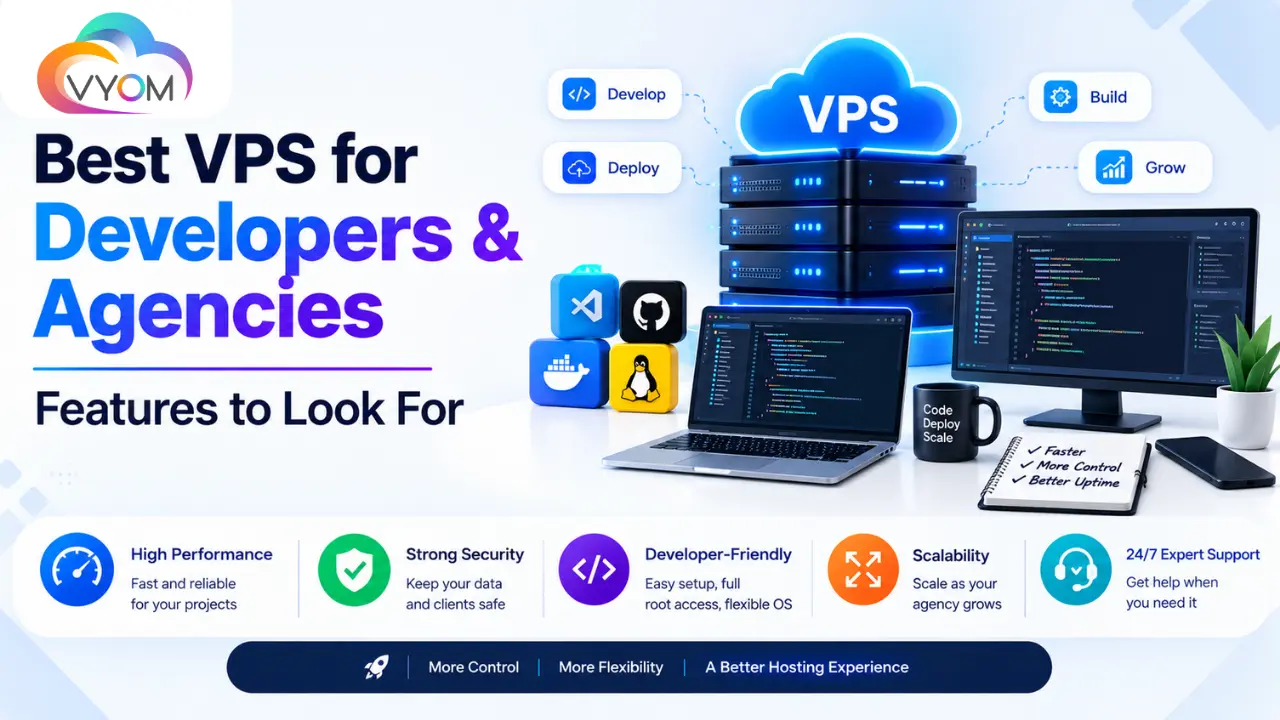
- Best Virtual Private Server for Developers & Agencies
- Why Developers and Agencies Choose VPS Hosting
- Key Features to Look for in a Developer VPS
- VPS Features Agencies Should Not Ignore
- Managed vs Unmanaged VPS
- How Much VPS Capacity Do You Need?
- What Makes a VPS the Best Choice?
- Final Verdict
- Related Reading
- FAQs
Best Virtual Private Server for Developers & Agencies
Developers and digital agencies need more from hosting than simply a place to keep a website online. A typical workload can include staging environments, client websites, APIs, databases, Git repositories, Docker containers, automation tools, and multiple applications running at the same time.
That is where a Virtual Private Server (VPS) becomes useful. It provides dedicated resources within a virtualized environment, giving developers much more control than shared hosting while generally costing less than a dedicated physical server.
But the best VPS for developers and agencies is not necessarily the one with the highest specifications. The right choice depends on workload, deployment requirements, scalability, security, and how much server management your team is comfortable handling.
Why Developers and Agencies Choose VPS Hosting
Shared hosting can become restrictive as projects grow. Resource limits, limited server access, and restrictions on software installation can make development and deployment more complicated.
A VPS offers a middle ground. Developers can usually configure the operating system, install required packages, deploy applications, manage databases, and create custom server environments.
For agencies, another major advantage is the ability to host several client projects on one server. Instead of purchasing separate hosting for every small application, an agency can organize multiple websites and services on a properly sized VPS.
Key Features to Look for in a Developer VPS
1. Strong CPU and RAM
CPU and RAM directly affect how comfortably your applications run. A small portfolio website may work perfectly with 2 GB RAM, while multiple applications, databases, containers, and development environments may require considerably more.
For agencies, starting with 4 GB to 8 GB RAM can provide a more practical foundation, depending on the number of projects being hosted.
2. NVMe or SSD Storage
Storage is not only about capacity. Fast storage can improve application responsiveness, database operations, backups, and deployment processes.
NVMe SSD storage is particularly attractive for developers handling databases, containerized applications, build processes, or large project files.
3. Root or Administrator Access
Full server access is one of the biggest reasons developers choose VPS hosting.
With appropriate access, you can install packages, configure firewalls, deploy frameworks, manage services, create users, configure web servers, and customize the environment according to project requirements.
4. Flexible Operating System Choices
A good developer VPS should support popular Linux distributions such as Ubuntu and Debian. Windows VPS hosting can also be useful when a project depends on Windows-specific software, technologies, or applications.
The ability to select or reinstall an operating system makes the VPS more adaptable as project requirements change.
5. Reliable Network Connectivity
A powerful server is of limited value if its network connection is unreliable.
Look for adequate bandwidth, stable connectivity, low network latency for your target audience, and transparent information about network limits. Agencies hosting client applications should pay particular attention to network reliability because one infrastructure issue can affect multiple projects.
VPS Features Agencies Should Not Ignore
Agencies have different priorities from individual developers. They need hosting that can grow alongside their client base.
Scalability is therefore important. You may begin with a small VPS and later need additional CPU, RAM, storage, or bandwidth.
Backups are equally important. A VPS gives you more control, but it also means you have greater responsibility. Automated backups and reliable restoration options can be extremely valuable when a deployment goes wrong or data is accidentally deleted.
Security should also be part of the selection process. Features such as firewall configuration, SSH security, regular updates, monitoring, DDoS protection options, and backup systems can help reduce operational risks.
Managed vs Unmanaged VPS
Developers who are comfortable with Linux administration may prefer an unmanaged VPS because it offers greater control and can reduce hosting costs.
A managed VPS can make more sense for agencies that want the provider to handle tasks such as server maintenance, updates, monitoring, and troubleshooting.
The choice depends on your team’s technical skills. If your developers already manage Linux servers, unmanaged hosting can provide excellent flexibility. If server administration takes time away from client work, managed hosting may offer better overall value.
How Much VPS Capacity Do You Need?
There is no universal configuration for every developer or agency.
A basic development server may work with:
- 2 CPU cores
- 2–4 GB RAM
- 50–80 GB SSD/NVMe storage
A growing agency hosting multiple websites and applications may prefer:
- 4–8 CPU cores
- 8–16 GB RAM
- 100 GB+ NVMe storage
The important thing is to match resources to actual workloads rather than paying for specifications you will never use.
What Makes a VPS the Best Choice?
The best VPS for developers and agencies should offer a balance of performance, control, reliability, security, scalability, and price.
Instead of choosing a provider solely because it advertises the most CPU cores or storage, evaluate the complete package. Check resource allocation, virtualization technology, storage type, network quality, backup options, support, operating system choices, and upgrade policies.
For agencies, also consider how easily the server can be reorganized as new clients arrive. A flexible VPS can become a central infrastructure platform for websites, APIs, staging environments, internal tools, and client applications.
Final Verdict
A VPS is an excellent hosting option for developers and digital agencies that have outgrown shared hosting but do not necessarily need a dedicated physical server.
For development work, prioritize root access, fast NVMe storage, sufficient RAM, flexible operating systems, reliable networking, and scalability. Agencies should additionally focus on backups, security, monitoring, support, and predictable pricing.
The best virtual private server is ultimately the one that fits your workload today while giving you enough room to grow tomorrow.
Related Reading
What is a VPS? A Detailed Guide to Virtual Private Servers
Best VPS Hosting in India 2026 | High-Performance VPS by Vyom Cloud
Also Read: Cheapest VPS Hosting Provider in India [September 2026]
Let’s Get Social:
Facebook: https://www.facebook.com/vyomcloudnetwork/
LinkedIn: https://www.linkedin.com/company/vyomcloud/
Instagram: https://www.instagram.com/vyomcloud/
FAQs
What is the best VPS for developers?
The best VPS for developers should provide reliable CPU and RAM resources, fast SSD or NVMe storage, root access, flexible operating system options, good networking, and the ability to scale as projects grow.
How much RAM does a developer VPS need?
A small development project may work with 2–4 GB RAM. Developers running databases, Docker containers, staging environments, or multiple applications may benefit from 8 GB or more.
Is VPS hosting good for digital agencies?
Yes. A VPS can allow an agency to host multiple client websites, applications, APIs, databases, and staging environments on a single infrastructure platform.
Should developers choose managed or unmanaged VPS hosting?
Unmanaged VPS hosting is suitable for developers who are comfortable managing servers. Managed VPS hosting can be preferable when an agency wants to spend less time on server administration and maintenance.
Is NVMe storage important for a VPS?
NVMe storage can provide faster disk performance than traditional storage, which can be useful for databases, application workloads, deployments, and other I/O-intensive development tasks.
Can I host multiple websites on one VPS?
Yes. A properly configured VPS can host multiple websites and applications. The number depends on the available CPU, RAM, storage, software configuration, and workload of each project.
Is Linux or Windows VPS better for developers?
Linux is commonly preferred for many web development workloads because of its ecosystem and flexibility. Windows VPS can be a better fit for applications that specifically require Windows technologies or software.