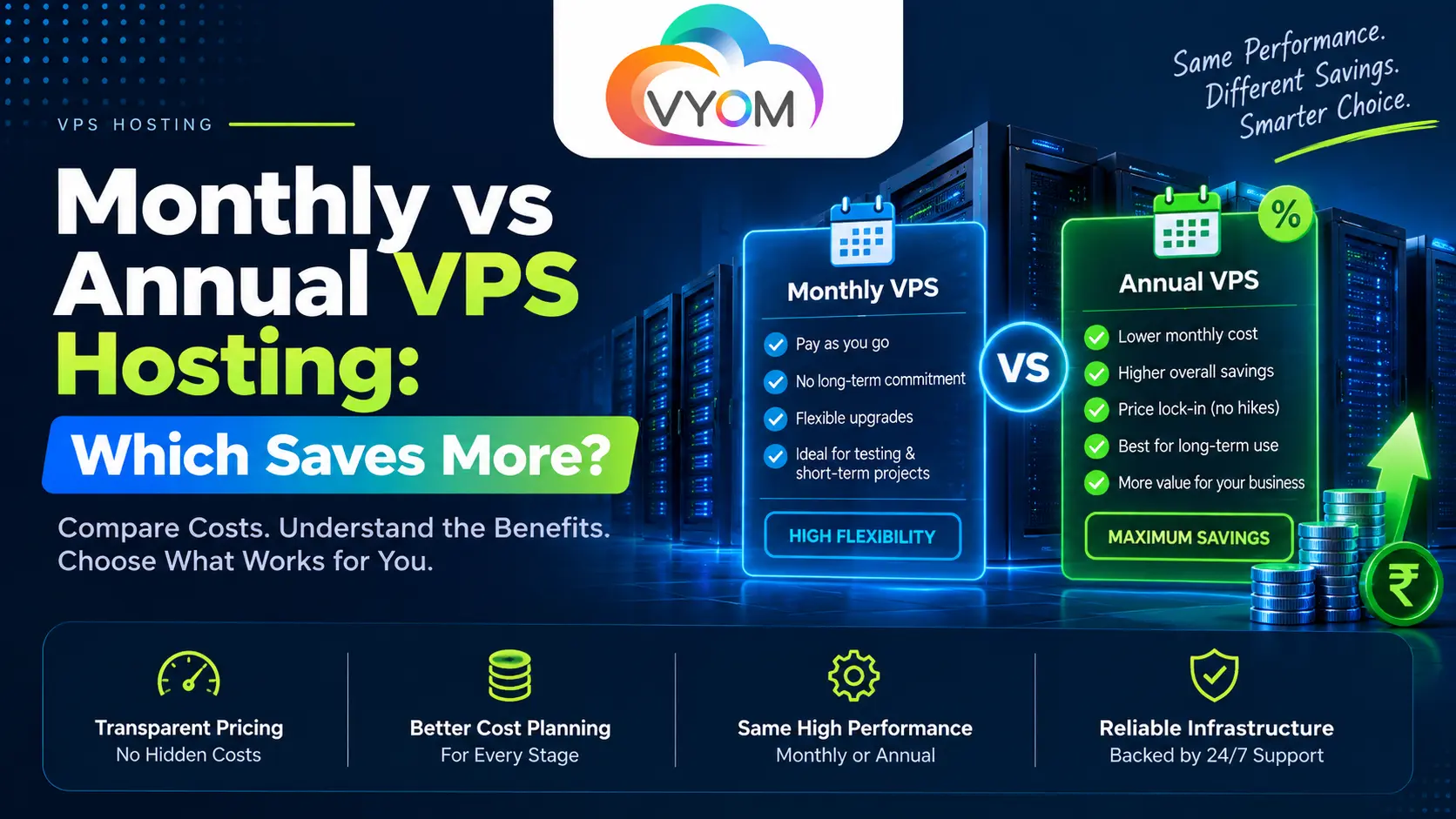
- Monthly vs Annual VPS Hosting: Which Saves More?
- Monthly vs Annual VPS Hosting: What’s the Difference?
- How Much Can You Save With Annual VPS Hosting?
- When Monthly VPS Billing Makes More Sense
- When Annual VPS Billing Makes More Sense
- Watch Out for VPS Renewal Pricing
- Hidden VPS Hosting Costs to Check
- Monthly vs Annual VPS Hosting: A Simple Decision Framework
- Frequently Asked Questions
- Is annual VPS hosting always cheaper than monthly?
- Can I switch from monthly to annual billing later?
- Can I pay for a VPS monthly and switch to annual billing later?
- What happens if I cancel an annual VPS plan early?
- Does the price I see at checkout stay the same at renewal?
- Is monthly billing a sign a provider isn’t confident in their service?
- Is monthly or annual VPS hosting better for a small business?
- Which billing cycle should I choose for a production website?
Monthly vs Annual VPS Hosting: Which Saves More?
Annual VPS hosting usually has a lower effective monthly rate than paying month to month, but cheaper only holds if you actually use the server for the full term. Cancel an annual plan early, and the math can flip against you. The right choice depends less on the sticker price and more on how certain you are about your project’s timeline. Here’s the full breakdown, including the parts most comparisons skip. anyone about to buy VPS hosting and deciding between monthly and annual billing, whether you’re running a production website, testing infrastructure, or scaling a client project.
Monthly vs Annual VPS Hosting: What’s the Difference?
On the surface, this looks like a simple price comparison. In practice, three separate things are bundled into that one decision:
- Price per month, annual plans typically carry a lower effective monthly rate, since the provider trades a discount for the certainty of a longer commitment.
- Upfront cost, monthly billing spreads cost out; annual billing asks for a bigger one-time payment.
- Flexibility, monthly plans let you cancel, downgrade, or walk away with minimal loss; annual plans lock in a rate but also lock in a commitment.
| Factor | Monthly VPS | Annual VPS |
| Upfront cost | Lower | Higher |
| Effective monthly price | Usually higher | Usually lower |
| Flexibility | High | Lower |
| Long-term savings | Usually lower | Usually higher |
| Best for | Testing / uncertain projects | Stable production workloads |
Most people only compare the first row. The other three are usually what actually decides which one is right for a given situation.
How Much Can You Save With Annual VPS Hosting?
Let’s put real numbers on it, using a typical entry-level VPS plan as an example, treat this as an illustration of the pattern, not a specific price quote. Check VyomCloud’s current plans for exact figures before publishing any number as fact.
| Billing | Monthly Equivalent | Annual Cost |
| Monthly | ₹700 | ₹8,400 |
| Annual | ₹550 | ₹6,600 |
| Annual saving | ₹150/month | ₹1,800/year (~21.4%) |
Annual plans often have a lower effective monthly rate, although the exact discount varies considerably by provider and by whatever promotion is running at the time, treat any specific percentage, including the one above, as an example rather than a guaranteed industry number.
The figure that actually matters isn’t the sticker price, it’s the total cost over the period you’ll actually use the server. If you’re planning to run a VPS for a year or more regardless of billing cycle, annual billing is close to a free discount. If you’re not sure you’ll keep the server that long, that “discount” can turn into a bigger loss than the monthly premium would have been.
When Monthly VPS Billing Makes More Sense
Despite the math often favoring annual plans, there are real situations where monthly billing is the smarter buy:
- You’re testing infrastructure. If you’re not yet sure this VPS plan, provider, or even project will still exist in three months, paying monthly limits your downside.
- The project timeline is genuinely uncertain. Short-term client work, a proof of concept, or a seasonal campaign server doesn’t benefit from a year-long commitment you might not need past month two.
- You want to evaluate the provider first. Running your workload on a new provider for a billing cycle or two before committing annually is a reasonable way to de-risk the decision.
- Cash flow matters more than the discount. For a small business or a solo developer, spreading cost monthly can matter more than an annual saving, especially early on.
None of these are wrong reasons to pay more per month. They’re trade-offs, and for the right situation, they’re the correct one.
When Annual VPS Billing Makes More Sense
On the other side, annual billing tends to be the better call when:
- You’re running a stable, ongoing production workload, a live website, an application backend, anything you already know will be running in twelve months.
- You want to lock in your current rate. On many hosting plans, the price at renewal isn’t guaranteed to match the price you signed up at, paying annually at today’s rate can protect you from a mid-year increase, so it’s worth confirming this directly with any provider before assuming it applies.
- You want fewer billing events to manage. One annual invoice is simpler to budget and track than twelve recurring charges, especially across multiple servers.
- You’ve already tested the provider and know the plan fits, at that point, the discount is close to free money.
Watch Out for VPS Renewal Pricing
Here’s the part that catches people off guard, regardless of which cycle they pick: the price you see at checkout isn’t always the price you’ll pay at renewal.
Some hosting providers advertise an introductory rate that only applies to the first billing cycle, monthly or annual, with the renewal rate reverting to a higher number afterward. This isn’t universal, but it’s frequent enough in the hosting industry generally that it’s worth confirming rather than assuming either way. Before committing to either cycle, ask directly:
- Is this the renewal price, or an introductory rate?
- Does the discount apply again if I renew annually next year, or only on the first purchase?
- Is there a price-lock guarantee for existing customers?
A clear, upfront answer to these three questions tells you more about a provider’s pricing transparency than the headline number ever will.
Hidden VPS Hosting Costs to Check
Before deciding purely on the monthly-vs-annual math, check a few things that can shift the real comparison:
- Setup fees. Some providers waive setup fees only on annual plans, effectively widening the gap beyond just the monthly rate difference.
- Refund and cancellation policy. If you commit annually and need to cancel early, does the provider offer a pro-rated refund, or do you forfeit the remaining months? Confirm the specific policy rather than assuming a standard one applies.
- Migration flexibility. If your needs outgrow the plan, can you upgrade mid-cycle without losing the annual discount, or does upgrading force a fresh commitment?
- What’s bundled in. Backups, a control panel license, or a dedicated IP are sometimes included free on annual plans but billed separately on monthly ones, factor that into the real total, not just the base VPS rate.
Monthly vs Annual VPS Hosting: A Simple Decision Framework
If you want a quick way to settle this instead of running the math every time, ask yourself three questions:
- Will this server still be running in 12 months? If yes, annual billing is very likely the better deal.
- Am I still evaluating this provider or this exact plan? If yes, start monthly, and switch to annual once you’re confident.
- Does an unexpected price increase at renewal matter to my budget? If a rate hike would genuinely hurt, locking in an annual rate now protects you from it.
Two or more answers pointing toward stability and commitment usually means annual billing saves more, both in the short-term rate and in avoided renewal surprises. If your answers lean toward uncertainty, pay monthly until they don’t.
Related Reading
- Good VPS Hosting on a Budget: Is It Even Possible?
- Best Cloud Hosting Providers for Indian Startups in May 2026
- What is VPS? A Detailed Guide to Virtual Private Servers
- Managed vs Unmanaged VPS Hosting: Which Suits Your Business?
Let’s Get Social:
Facebook: https://www.facebook.com/vyomcloudnetwork/
LinkedIn: https://www.linkedin.com/company/vyomcloud/
Instagram: https://www.instagram.com/vyomcloud/
Frequently Asked Questions
Is annual VPS hosting always cheaper than monthly?
Usually cheaper on a per-month basis, but whether it’s cheaper for you depends on whether you’ll actually use the server for the full term, canceling an annual plan early can erase the savings.
Can I switch from monthly to annual billing later?
Most providers allow this, though the process, and whether the annual rate applies retroactively to your remaining term, varies. Check this specifically before assuming you can switch freely.
Can I pay for a VPS monthly and switch to annual billing later?
Yes, in most cases, though you’d typically move to the annual rate starting from the point of the switch rather than getting it backdated. Confirm the exact mechanics with your provider.
What happens if I cancel an annual VPS plan early?
This depends entirely on the provider’s refund policy, some offer a pro-rated refund for unused months, others don’t. Confirm this before committing to annual billing, especially for a workload you’re not fully certain about.
Does the price I see at checkout stay the same at renewal?
Not always. Some providers apply an introductory rate to the first billing cycle only, with a higher rate at renewal. Ask directly whether the quoted price is the renewal price, not just the first-purchase price.
Is monthly billing a sign a provider isn’t confident in their service?
No, many reputable providers offer monthly billing specifically because it lowers the barrier for customers who want to test infrastructure before committing. It’s a normal and common option, not a red flag on its own.
Is monthly or annual VPS hosting better for a small business?
It depends on the workload. A small business running a live, ongoing website or application generally benefits from annual billing’s lower rate; a small business still validating a new product or service may prefer the flexibility of monthly billing until the project’s staying power is clearer.
Which billing cycle should I choose for a production website?
If the site or application is already live and expected to keep running, annual billing usually makes more sense, you’ll typically pay less per month and reduce the risk of a renewal price increase mid-year.