
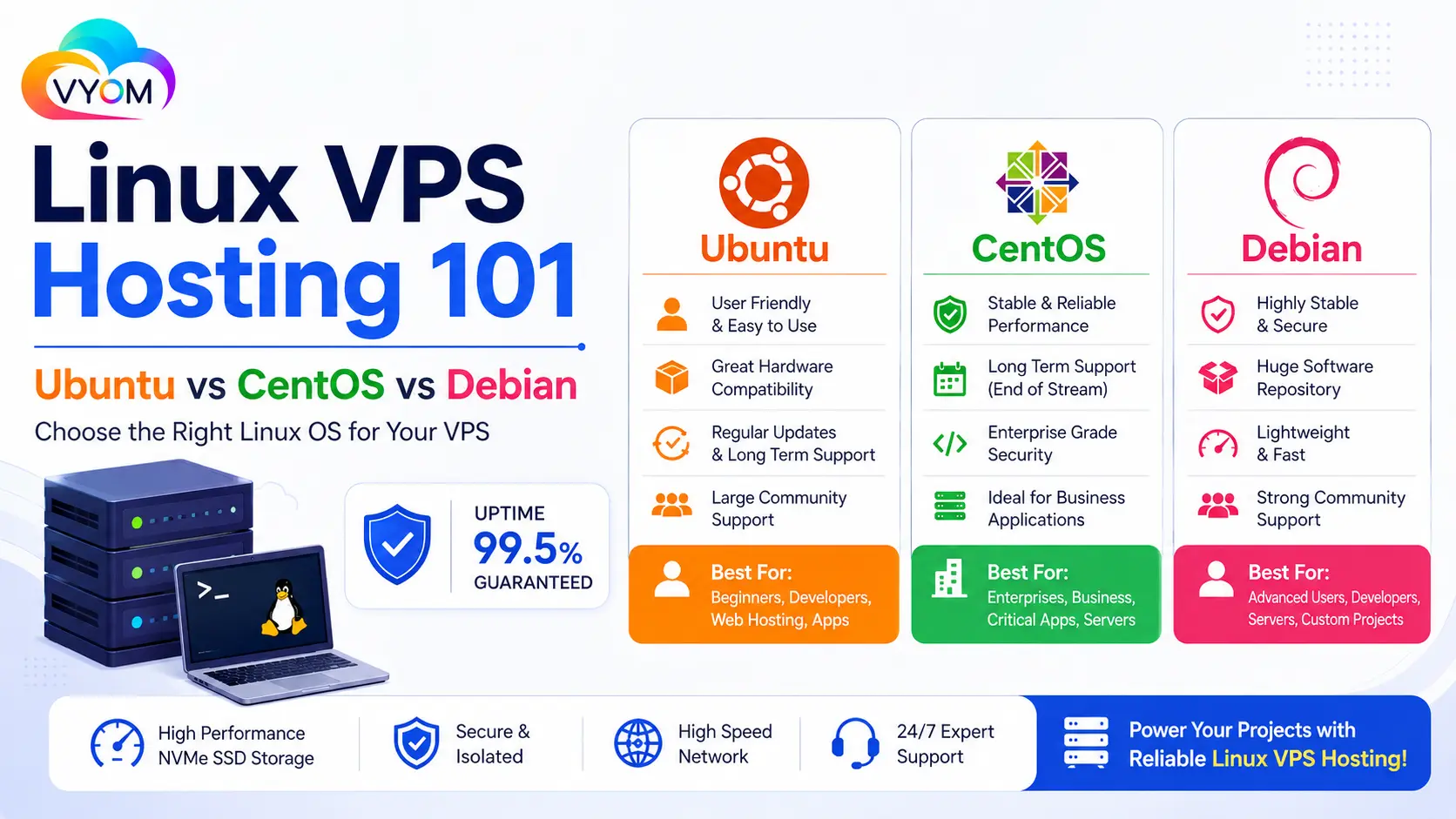
- Linux VPS Hosting 101: Choosing Between Ubuntu, CentOS & Debian
- What Is a Linux VPS?
- Ubuntu vs CentOS vs Debian: What’s the Difference?
- Ubuntu vs Debian: Which Is Better?
- Is CentOS Still a Good Choice for VPS Hosting?
- Which Linux VPS OS Should Beginners Choose?
- What About VPS Performance?
- How to Choose the Right Linux VPS
- Conclusion
- Related Reading
- FAQs
- Is Ubuntu better than Debian for VPS hosting?
- Is CentOS still available for VPS hosting?
- Which Linux is best for a beginner VPS?
- Is Debian lighter than Ubuntu?
- Can I change Linux distribution on my VPS?
- Which Linux distribution is best for WordPress VPS hosting?
- Does Linux VPS hosting require technical knowledge?
Linux VPS Hosting 101: Choosing Between Ubuntu, CentOS & Debian
Choosing a Linux distribution is one of the first decisions you’ll face when setting up a VPS. The server hardware may have plenty of CPU, RAM and storage, but the operating system determines how you manage that server, install software, apply updates and maintain security.
For most VPS users, the choice eventually comes down to Ubuntu, CentOS or Debian. All three are popular Linux-based server environments, but they are designed around slightly different priorities.
So, which one should you choose for your VPS?
The answer depends on your experience, applications and how much control you want over the server.
What Is a Linux VPS?
A Linux VPS is a virtual private server running a Linux operating system. Unlike shared hosting, a VPS gives you dedicated virtual resources and generally provides root or administrator access.
You can install applications, configure web servers, create databases and host websites according to your requirements.
Linux VPS hosting is commonly used for:
- WordPress and other websites
- Web applications
- Docker containers
- Development environments
- Databases
- Game servers
- VPNs and networking tools
- APIs and backend applications
- Self-hosted software
The operating system is the foundation on which all of these services run.
Ubuntu vs CentOS vs Debian: What’s the Difference?
Ubuntu
Ubuntu is often the easiest starting point for people who are new to Linux VPS hosting.
It has a large user community, extensive documentation and broad compatibility with modern software. Many hosting tutorials and installation guides specifically provide Ubuntu commands, making it easier to troubleshoot problems.
Ubuntu is particularly suitable for:
- Beginners
- Web hosting
- Docker and container workloads
- Cloud applications
- Development servers
- Hosting control panels
For someone purchasing their first Linux VPS, Ubuntu is usually the safest choice.
Debian
Debian has a reputation for being stable, dependable and relatively lightweight. It follows a conservative approach to software packages, prioritising reliability over constantly introducing the newest versions.
That makes Debian attractive for production servers where stability matters more than having every latest package.
Choose Debian if you:
- Prefer a minimal server
- Value long-term stability
- Have some Linux experience
- Want a lightweight environment
- Don’t need the newest software immediately
Debian is also the upstream foundation for Ubuntu, although the two distributions have different release and package-management approaches.
CentOS
CentOS was historically one of the most popular Linux distributions for servers, particularly in hosting environments. However, the traditional CentOS Linux model reached its end of life, and the project shifted toward CentOS Stream.
This is important when selecting a new VPS.
CentOS Stream sits between Fedora and Red Hat Enterprise Linux (RHEL) in the Red Hat ecosystem and serves as a continuously delivered preview of what is heading toward the next RHEL minor release.
For new deployments, users who specifically want the traditional RHEL-style ecosystem may also consider distributions such as Rocky Linux or AlmaLinux.
Ubuntu vs Debian: Which Is Better?
There isn’t a universal winner.
Ubuntu generally has the advantage for beginners because tutorials, community support and third-party software compatibility are easy to find.
Debian can be an excellent option when you want a clean, stable and relatively minimal server.
If you’re learning Linux administration for the first time, Ubuntu will probably save you time. If you already understand Linux and prefer a conservative environment, Debian is worth considering.
Is CentOS Still a Good Choice for VPS Hosting?
CentOS Stream can still make sense for specific workloads, particularly when you deliberately want to stay within the Red Hat ecosystem.
However, you shouldn’t select it simply because an old tutorial recommends “CentOS.” Always check whether the tutorial was written for CentOS Linux or CentOS Stream.
For a new general-purpose VPS, Ubuntu or Debian will often be simpler choices.
Which Linux VPS OS Should Beginners Choose?
If you’re completely new to VPS hosting, Ubuntu is the easiest recommendation.
Its extensive documentation and large community mean that you’re likely to find solutions when something goes wrong. Many popular applications also publish Ubuntu installation instructions.
A simple rule of thumb is:
Beginner → Ubuntu
Stability-focused experienced user → Debian
RHEL ecosystem / specific enterprise requirement → CentOS Stream or a RHEL-compatible alternative
What About VPS Performance?
The Linux distribution itself is rarely the biggest factor determining VPS performance.
CPU allocation, RAM, storage technology, network quality and server configuration generally have a much greater impact.
A lightweight Linux installation can still help reduce unnecessary resource consumption, but choosing Debian over Ubuntu won’t automatically make a poorly configured VPS fast.
For most small websites and applications, 2–4 GB RAM and SSD/NVMe storage can provide a reasonable starting point, although actual requirements depend heavily on the workload.
How to Choose the Right Linux VPS
Before ordering a VPS, consider more than the operating system.
Check:
- CPU cores and allocation
- RAM
- SSD or NVMe storage
- Network bandwidth
- Datacenter location
- IPv4/IPv6 availability
- Backup options
- DDoS protection
- Root access
- Support quality
- Operating system availability
Also check whether the provider allows you to reinstall or change the operating system later. This gives you flexibility if your requirements change.
Conclusion
For most people starting with Linux VPS hosting in 2026, Ubuntu is the best all-round choice because it combines ease of use, documentation and broad software support.
Debian is an excellent alternative for users who prioritise stability and a clean, minimal server environment.
CentOS Stream remains relevant for users who specifically need the Red Hat ecosystem, but it should not be confused with the older CentOS Linux releases that many legacy tutorials still reference.
Ultimately, the best Linux VPS operating system is the one that matches your application and technical experience. Your choice of VPS provider, hardware resources and server configuration can be just as important as the distribution itself.
Related Reading
What is VPS? A Detailed Guide to Virtual Private Servers
Best VPS Hosting in India 2026 | High Performance VPS by Vyom Cloud
Also Read:- How to Build Automation Workflows Using n8n
Let’s Get Social:
Facebook: https://www.facebook.com/vyomcloudnetwork/
LinkedIn: https://www.linkedin.com/company/vyomcloud/
Instagram: https://www.instagram.com/vyomcloud/
FAQs
Is Ubuntu better than Debian for VPS hosting?
Ubuntu is generally easier for beginners because of its extensive documentation and community support. Debian is a strong choice for experienced users who prefer stability and a minimal server environment.
Is CentOS still available for VPS hosting?
CentOS Stream is available, but traditional CentOS Linux has reached end of life. New deployments should understand the difference between CentOS Stream and the older CentOS Linux releases.
Which Linux is best for a beginner VPS?
Ubuntu is usually the easiest Linux distribution for beginners because many hosting tutorials, software projects and troubleshooting resources use Ubuntu.
Is Debian lighter than Ubuntu?
Debian can be installed with a very minimal package set, so it can be extremely lightweight. However, the actual resource usage depends on what services and packages you install.
Can I change Linux distribution on my VPS?
Many VPS providers allow you to reinstall the server with another supported operating system. Reinstallation normally erases the existing server data, so backups are essential.
Which Linux distribution is best for WordPress VPS hosting?
Ubuntu and Debian are both suitable for WordPress. Ubuntu is often easier for beginners, while Debian is attractive to administrators who prefer a minimal and stable server.
Does Linux VPS hosting require technical knowledge?
Some Linux knowledge is helpful because VPS users commonly manage servers through SSH and the command line. Managed VPS hosting can reduce the amount of server administration required.

One Response