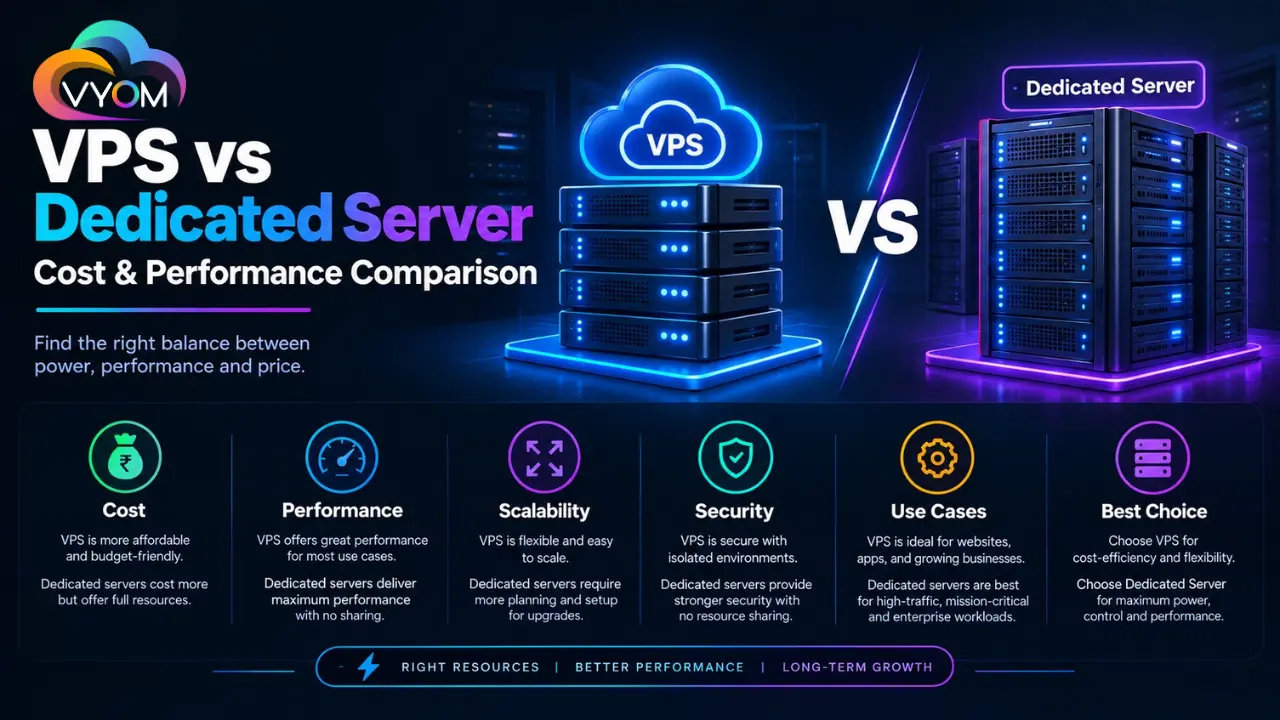
- VPS vs Dedicated Server: A Full Cost & Performance Breakdown
- What Is a VPS?
- What Is a Dedicated Server?
- VPS vs Dedicated Server: Cost Comparison
- Performance: VPS vs Dedicated Server
- Scalability
- Security and Isolation
- Management and Technical Requirements
- Which One Should You Choose?
- Final Verdict
- Related Reading
- FAQs
- Is a VPS cheaper than a dedicated server?
- Is a dedicated server faster than a VPS?
- When should I upgrade from VPS to a dedicated server?
- Is VPS hosting good for high-traffic websites?
- Which is better for developers: VPS or dedicated server?
- Is a dedicated server more secure than a VPS?
- Can I upgrade a VPS to a dedicated server later?
- Does a dedicated server require more technical knowledge?
VPS vs Dedicated Server: A Full Cost & Performance Breakdown
Choosing between a VPS and a dedicated server is an important decision when shared hosting is no longer enough. Both options provide more resources and control, but they work differently and suit different workloads.
A VPS (Virtual Private Server) divides a physical server into isolated virtual environments, while a dedicated server gives one customer access to the entire physical machine.
The right choice depends on your budget, workload, performance requirements, scalability needs, and technical expertise. Here’s a practical breakdown to help you understand the differences.
What Is a VPS?
A VPS uses virtualization technology to create an isolated server environment on a physical machine. Multiple VPS instances can operate on the same physical server while maintaining separate operating systems, resources, and configurations.
VPS hosting is popular because it provides many server-level controls without the cost of renting an entire physical server.
Typical VPS features include:
- Allocated vCPU resources
- Dedicated or allocated RAM
- SSD or NVMe storage
- Root or administrator access
- Flexible operating systems
- Scalable configurations
- Virtualized networking
A VPS can be suitable for websites, APIs, development environments, e-commerce stores, databases, and small-to-medium applications.
What Is a Dedicated Server?
A dedicated server is a complete physical server assigned to one customer.
There is no sharing of the physical machine’s CPU, RAM, or storage with other customers. This makes dedicated servers particularly useful for workloads that require consistently high resources or specific hardware configurations.
Dedicated servers are commonly used for:
- High-traffic websites
- Large databases
- Enterprise applications
- Game servers
- Video and media workloads
- Virtualization environments
- Resource-intensive business applications
The trade-off is that dedicated servers generally cost more and can require greater infrastructure planning.
VPS vs Dedicated Server: Cost Comparison
Cost is usually the first major difference users notice.
A VPS can start at a relatively low monthly price because the underlying physical infrastructure is shared between multiple customers.
A dedicated server costs more because the customer is effectively renting an entire physical machine. Hardware configuration also has a major impact on pricing.
| Factor | VPS | Dedicated Server |
|---|---|---|
| Starting Cost | Lower | Higher |
| Hardware | Virtualized | Entire physical machine |
| CPU | Allocated vCPU | Physical CPU |
| RAM | Allocated | Dedicated physical RAM |
| Storage | Virtualized storage | Dedicated drives |
| Scalability | Usually easier | Often requires hardware change |
| Performance | Strong for many workloads | High and consistent |
| Management | Managed/unmanaged | Managed/unmanaged |
| Best For | Growing workloads | Resource-intensive workloads |
However, price should not be evaluated in isolation. A VPS that requires frequent upgrades or additional services can eventually cost more than expected.
Performance: VPS vs Dedicated Server
A dedicated server has a fundamental hardware advantage: all physical resources belong to one customer.
This makes it easier to maintain predictable performance for demanding workloads.
A VPS can still deliver excellent performance, particularly when the provider uses modern CPUs, fast NVMe storage, sufficient RAM, and quality virtualization infrastructure.
For most websites and applications, a properly sized VPS can provide more than enough performance.
The difference becomes more important when workloads consistently consume large amounts of CPU, RAM, disk I/O, or network capacity.
Scalability
VPS hosting generally has an advantage when it comes to quick resource scaling.
Depending on the provider, you may be able to increase CPU, RAM, or storage without moving to a completely different physical machine.
Dedicated server upgrades can be more involved. If you need substantially more processing power or RAM, you may need to migrate to another physical server or schedule hardware changes.
For startups, agencies, and growing applications, this flexibility can make VPS hosting easier to manage.
Security and Isolation
Both VPS and dedicated servers can be configured securely, but their infrastructure models differ.
A VPS provides isolation between virtual environments. A dedicated server eliminates the multi-tenant physical environment altogether.
Neither option automatically makes an application secure. Security still depends on operating system updates, firewall configuration, access controls, application security, backups, monitoring, and server administration.
Management and Technical Requirements
Both VPS and dedicated servers can be managed or unmanaged.
With unmanaged hosting, the customer typically handles operating system updates, software installation, security configuration, troubleshooting, and maintenance.
Managed services can reduce the administrative workload but usually increase the overall hosting cost.
For developers and system administrators, unmanaged hosting may provide the control they need. Businesses without technical staff may prefer managed infrastructure.
Which One Should You Choose?
A VPS can be a practical choice when you need:
- Lower initial cost
- Flexible resource upgrades
- Root access
- Development and staging environments
- Hosting for multiple websites
- Small or medium applications
- Easy infrastructure scaling
A dedicated server may make more sense when you need:
- Consistently high CPU performance
- Large amounts of RAM
- Heavy database workloads
- High disk I/O
- Specialized physical hardware
- Maximum physical resource isolation
The workload should determine the infrastructure rather than simply choosing the more powerful option.
Final Verdict
VPS and dedicated servers are both capable hosting solutions, but they serve different requirements.
A VPS offers a strong balance between cost, control, performance, and scalability, making it suitable for many websites, applications, developers, agencies, and growing businesses.
A dedicated server provides the resources of an entire physical machine and can be appropriate for consistently demanding workloads where predictable physical performance is important.
Before upgrading, monitor your current CPU, RAM, storage, network, and application requirements. If your workload can comfortably run on a VPS, moving directly to a dedicated server may add unnecessary infrastructure costs. If your applications consistently require more physical resources than a VPS can efficiently provide, dedicated hosting becomes a more relevant option.
Related Reading
What is a VPS? A Detailed Guide to Virtual Private Servers
Best VPS Hosting in India 2026 | High-Performance VPS by Vyom Cloud
Also Read: Cheapest VPS Hosting Provider in India [September 2026]
Let’s Get Social:
Facebook: https://www.facebook.com/vyomcloudnetwork/
LinkedIn: https://www.linkedin.com/company/vyomcloud/
Instagram: https://www.instagram.com/vyomcloud/
FAQs
Is a VPS cheaper than a dedicated server?
Generally, VPS hosting has a lower entry price because the physical infrastructure is shared among multiple virtual servers. Dedicated servers cost more because one customer receives the complete physical machine.
Is a dedicated server faster than a VPS?
A dedicated server can provide more predictable physical performance because its CPU, RAM, storage, and other hardware are not shared with other customers. However, a well-configured VPS can perform very well for many workloads.
When should I upgrade from VPS to a dedicated server?
Consider a dedicated server when your application consistently requires substantial CPU, RAM, storage I/O, network capacity, or specialized hardware that a VPS cannot efficiently provide.
Is VPS hosting good for high-traffic websites?
Yes. A properly configured VPS can handle substantial traffic. Performance depends on the application’s efficiency, available resources, caching, database configuration, and network capacity.
Which is better for developers: VPS or dedicated server?
It depends on the project. VPS hosting is often convenient for development, testing, APIs, and smaller production applications because it offers flexibility at a lower cost. Dedicated servers become more relevant for resource-intensive projects.
Is a dedicated server more secure than a VPS?
A dedicated server removes the multi-tenant physical environment, but security still depends heavily on server configuration, operating system maintenance, application security, access controls, backups, and monitoring.
Can I upgrade a VPS to a dedicated server later?
Yes. You can migrate an application from a VPS to a dedicated server when its resource requirements increase. Planning backups, data migration, DNS changes, and application testing makes the transition easier.
Does a dedicated server require more technical knowledge?
Not necessarily. Both VPS and dedicated servers can be offered as managed or unmanaged services. Managed hosting can reduce the amount of server administration required.