- Why Enterprises Choose Cage Colocation for Secure IT Infrastructure
- What Is Cage Colocation?
- How it works
- Why enterprises use it
- Top Benefits of Cage Colocation
- Cage Colocation vs Rack Colocation
- Industries That Benefit from Cage Colocation
- How to Choose the Right Cage Colocation Provider
- Why Choose VyomCloud for Cage Colocation?
- Conclusion
- Related Reading
- FAQs
Why Enterprises Choose Cage Colocation for Secure IT Infrastructure
Enterprises today face escalating threats to data and uptime, while compliance demands and business continuity expectations rise. Secure IT infrastructure is no longer optional; it’s a strategic requirement. Cage colocation provides a dedicated, physically secured environment inside a colocation data center where businesses can house servers and network gear with strong isolation, controlled access, and enterprise-grade services. This model combines the advantages of a purpose-built data center—redundant power, cooling, and network redundancy—with private space and managed colocation options. For organisations that need secure server hosting, high availability, and clear compliance pathways, cage colocation is a compelling choice.
What Is Cage Colocation?
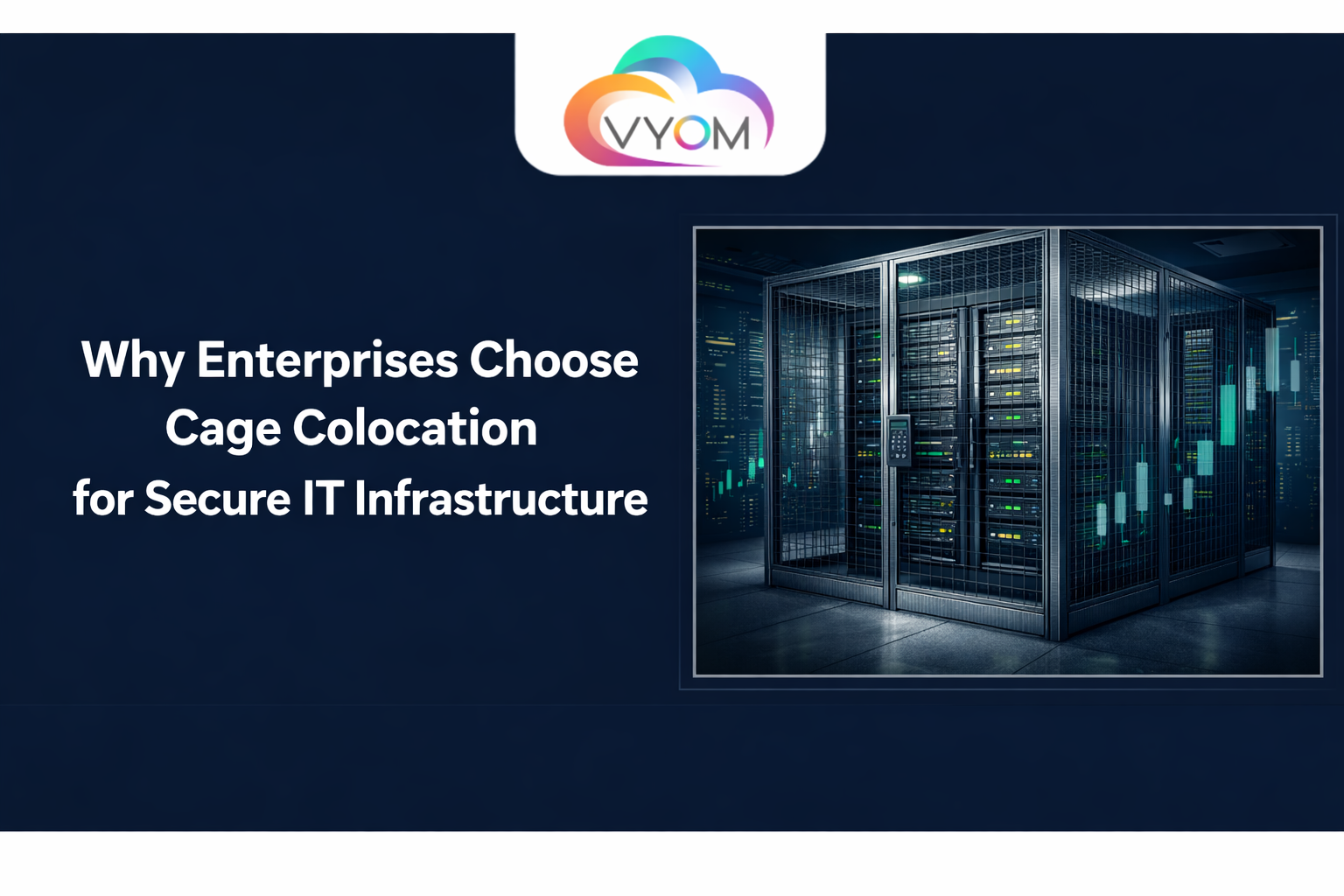
Cage colocation is a service where a provider installs a locked, fenced, or walled enclosure (the cage) inside a colocation data center to house a customer’s racks and equipment. The cage provides physical separation from other tenants while leveraging the facility’s shared infrastructure.
How it works
Customers supply servers or rent dedicated server infrastructure, and the provider allocates a secure cage area and rack colocation. The provider manages the facility’s power, cooling, and building-level security. Customers retain control of their hardware, with optional managed hosting or remote hands support for on-site tasks.
Why enterprises use it
Enterprises choose cage colocation for enhanced physical server security, compliance simplicity, and the ability to run custom configurations. Unlike shared rack space, cages reduce the chance of accidental access, tampering, or noisy neighbors and support stricter access controls and monitoring.
Difference between cage colocation and shared rack space
- Cage colocation: Private, physically segregated area, stronger privacy, customizable security, suitable for sensitive or regulated workloads.
- Shared rack space: Shared cabinets among multiple tenants, lower cost, faster deployment, but less privacy and control.
Why Secure IT Infrastructure Matters for Enterprises
Growing cyber threats
Cyberattacks continue to evolve. Physical security complements network security; protecting hardware at the colocation site reduces risk from insider threats and physical tampering.
Compliance requirements
Regulations such as data protection laws and industry standards require demonstrable controls. A cage in a Tier III data center simplifies audits and compliance for enterprises in finance, healthcare, and government.
Business continuity
Maintaining operations during outages or disasters is critical. Colocation hosting provides redundant power and disaster recovery facilities to keep services running.
Downtime costs
Unplanned downtime can cost enterprises thousands to millions per hour, depending on scale. High availability and uptime guarantees in colocation data centers reduce this financial exposure.
Data protection
Physical isolation and controlled access help prevent data breaches originating from unauthorized hardware access, supporting secure server hosting practices.
Top Benefits of Cage Colocation
Physical security
Cages add locked enclosures, CCTV, biometric access controls, and mantraps to protect hardware from unauthorized access.
Dedicated private space
A cage ensures only authorised personnel can access your servers, reducing the risk of accidental interference and improving privacy.
Better compliance
Private cages make it easier to meet standards like ISO 27001, PCI DSS, and local data protection regulations by providing clear physical control boundaries.
High uptime
Colocation providers often offer uptime guarantee SLAs backed by redundant systems, delivering consistent availability for critical services.
Scalability
Enterprises can scale by adding racks inside the cage or expanding cage space, combining predictable growth with physical segmentation.
Reliable connectivity
Colocation data centers offer multiple carriers and peering options, enabling low-latency connectivity and network redundancy for mission-critical applications.
Cost savings
Compared with building a private data center, cage colocation reduces capital expenditure while delivering enterprise-grade features and predictable operational costs.
Better cooling
Data centers provide efficient, often advanced cooling systems. Rack colocation inside a cage benefits from optimized airflow and thermal management.
Redundant power
Providers supply UPS, generators, and dual power feeds to ensure continuous operation during grid outages.
Disaster recovery
Cage colocation supports disaster recovery and business continuity strategies by allowing geographically diverse deployments and rapid failover.
Cage Colocation vs Rack Colocation
Comparison table
- Security: Cage colocation — High (private enclosure, restricted access). Rack colocation — Moderate (shared cabinet lock).
- Privacy: Cage colocation — Strong (exclusive area). Rack colocation — Limited (shared rack neighbors).
- Cost: Cage colocation — Higher (private space, more infrastructure). Rack colocation — Lower (shared resources).
- Scalability: Cage colocation — High (expandable cage). Rack colocation — Moderate (limited by cabinet availability).
- Access: Cage colocation — Controlled, scheduled access. Rack colocation — Easier, often on-demand access.
- Best use cases: Cage colocation — Regulated industries, sensitive workloads, enterprise colocation. Rack colocation — Small businesses, less sensitive services, cost-sensitive projects.
Industries That Benefit from Cage Colocation
Banking
Banks need strict data protection and audit trails; private cage colocation helps meet these requirements.
Healthcare
Patient data demands high privacy and compliance; cages support HIPAA-equivalent controls and secure server hosting.
Government
Sensitive government systems require physical isolation and strong access controls available with private cage colocation.
SaaS companies
SaaS platforms that serve enterprise clients rely on uptime, disaster recovery, and network redundancy available through colocation hosting.
E-commerce
Retailers need constant availability during traffic peaks; colocation data centers deliver high availability and connectivity.
Manufacturing
Industrial control systems and IIoT gateways benefit from dedicated infrastructure and secure, low-latency connections.
Media
Content providers require high bandwidth and reliable delivery; colocation centers provide multiple carrier options and peering.
Telecom
Telecommunications firms leverage cage colocation for core network elements, ensuring redundancy and regulatory compliance.
How to Choose the Right Cage Colocation Provider
Location
Choose a site near your user base for lower latency, but balanced against regional risk (natural disasters, power stability).
Tier III or Tier IV data center
Select a Tier III data center for strong redundancy, or Tier IV for fault-tolerant requirements. Confirm design and operational certifications.
Network connectivity
Check carrier diversity, bandwidth options, and peering relationships to ensure network redundancy and performance.
Physical security
Look for biometric access, CCTV coverage, mantraps, security staffing, and detailed access logs.
Technical support
24×7 technical support and expert staff shorten mean time to repair and help resolve incidents rapidly.
Remote hands support
On-site remote hands services let you request hardware tasks without travel, useful for managed colocation services.
Power redundancy
Verify UPS capacity, generator backups, and dual power feeds to maintain service during outages.
Cooling
Assess cooling architecture, hot-aisle/cold-aisle containment, and capacity for high-density racks.
Certifications
Request ISO, SOC, PCI, and other relevant certifications to validate operational and security standards.
Pricing
Compare TCO: rack space costs, power usage charges, remote hands fees, and managed hosting add-ons to find the best value.
Why Choose VyomCloud for Cage Colocation?
VyomCloud offers enterprise-grade infrastructure with cage colocation options inside a Tier III data center. The facility provides redundant power, advanced physical security, and high-speed connectivity designed for reliable enterprise hosting solutions. VyomCloud supports managed colocation services and 24×7 technical support, including remote hands, to simplify operations. Flexible colocation options let businesses scale while maintaining strict access controls and compliance readiness. Competitive pricing and strong uptime records make VyomCloud a practical choice for enterprises seeking secure server hosting and dedicated server infrastructure without the cost of building private data centers.
Conclusion
Cage colocation delivers a balanced path to secure IT infrastructure: private, physically protected space combined with the resilience and economies of a colocation data center. Enterprises gain improved data protection, simplified compliance, network redundancy, and disaster recovery capabilities while keeping operational costs reasonable. For organisations that require high availability, strong physical server security, and scalable dedicated server infrastructure, cage colocation is an effective strategy. Evaluate providers on location, Tier level, connectivity, security, and support to ensure alignment with your business continuity goals. For enterprises in India and beyond, choosing a provider with enterprise-grade infrastructure and managed colocation services—such as VyomCloud—can accelerate secure deployments and reduce operational risk.
Related Reading
https://www.vyomcloud.com/blog/how-to-train-ai-models-on-cloud-gpu-servers/
https://www.vyomcloud.com/blog/what-is-hermes-complete-beginner-guide/
Also Read:- https://www.vyomcloud.com/blog/hybrid-cloud-vs-multi-cloud-complete-guide/
Let’s Get Social:
Facebook: https://www.facebook.com/vyomcloudnetwork/
LinkedIn: https://www.linkedin.com/company/vyomcloud/
Instagram: https://www.instagram.com/vyomcloud/
FAQs
1. What is Cage Colocation?
Cage colocation is a colocation model where a customer’s servers are housed inside a locked, private enclosure within a colocation data center. It combines facility-level redundancy with physical isolation, offering stronger privacy and access controls than shared rack space.
2. What is the difference between Cage Colocation and Rack Colocation?
Cage colocation gives a dedicated, physically segregated area for equipment; rack colocation places gear in shared cabinets. Cages offer higher security and privacy, while rack colocation is usually more cost-effective and quicker to deploy.
3. Who should use Cage Colocation?
Enterprises with sensitive data, strict compliance needs, or mission-critical applications should use cage colocation. Banking, healthcare, government, and large SaaS platforms often prefer cages for added physical security and regulatory assurance.
4. Is Cage Colocation secure?
Yes. Cage colocation enhances data center security with locked enclosures, CCTV, biometric access, and access logs. Combined with network security and managed colocation services, cages offer strong protection for physical server security.
5. How much does Cage Colocation cost?
Costs vary by location, rack space, power consumption, and service level. Expect higher pricing than shared rack colocation due to private space and added security, but lower capital expense than building a private data center. Compare providers on TCO, uptime guarantee, and managed services.
6. Why choose VyomCloud for Cage Colocation?
VyomCloud combines enterprise-grade infrastructure with Tier III data center facilities, redundant power, high-speed connectivity, and 24×7 support. Flexible colocation options and managed colocation services help enterprises deploy secure server hosting with competitive pricing and high uptime.